Actress Model Divya Karkhur Gorgeous Hot And Sexy Pics
Read More
Actress Model Divya Karkhur Gorgeous Hot And Sexy Pics
Read More
A radiant Celebration of Light, Culture and Heritage took place on October 18th, 2025 at Gracie Mansion’s Conservancy in partnership with the International Museum of The Saree, Diwali was celebrated in style the Festival of Lights Tour. The afternoon opened with heartfelt remarks from Chioma Ohakam, GMC’s Director of Public Engagement, and guest speaker Dr. Vipul Patel, MD, who welcomed guests into “The People’s House.” They highlighted the importance of embracing cultural diversity, beauty, and unity within the historic halls of Gracie Mansion.
Guests were treated to an enchanting musical interlude by International Award Winning Artist world-renowned maestro Ustad Kamal Sabri, a leading figure in Indian Classical music. Performing on a 150-year-old sarangi passed down from his father, legendary Ustad Sabri Khan, Ustad Sabri’s soulful Diwali bhajans mesmerized the audience, bridging generations of musical tradition.
The evening continued with a moving poetic performance by Dr. Ashvini Persaud, who recited from the forthcoming literary book “Saree To The New World” and its accompanying musical album. Dr. Persaud seamlessly wove together live poetry, audience participation, and musical collaboration with Ustad Kamal Sabri, transforming the moment into a living archive of art and connection. Wearing a vintage Gujarati saree featured in the International Museum of The Saree, she embodied the spirit of cultural preservation.
The event welcomed a beautifully diverse gathering, including leaders of International Museum of The Saree, Suriname Permanent Mission, BAPS Sri Swaminarayan Mandir, GPK Foundation, Bengali International Literary Society, Sri Chinmoy Mission, Hrudayam Arts, South Asian Diasporas and local New Yorkers. Guests admired displays of illuminated diyas, colorful figurines and poetic stories by Dr. Persaud of Rama, Sita, and Lakshmi, and saree donated by Lakshmi Singh, honoring the goddess of prosperity.
A heartfelt thank-you to GMC Docent Mary Reynolds for leading guests through an inspiring tour of Gracie Mansion’s rich history and heritage while celebrating light, culture, and community and thanks to all the amazing guests who came out to support the first Diwali Tour at Gracie Mansion. International Museum of The Saree has been an influencer pop up museum directly and indirectly helping many organizations and leaders to develop inclusive perspectives in programming of cultural heritage and includes honorary members such as, Pt. Anup Jalota, Dilip Sen Rahul Roy and diplomatic diaspora families
For inquiries contact:
IG/FB: internationalmuseumofthesaree
Email: imofthesaree@gmail.com
WhatsApp: USA 917.993.2557
www.internationalmuseumofthesaree.org
First Diwali House Tour At Gracie Mansion Official House Of All New York Mayors With International Museum Of The Saree !
Read More
कर्णिका मंडल ‘याना…?’ की मुख्य अभिनेत्री के रूप में सुर्खियों में हैं, और प्रोडक्शन टीम के अनुसार, यह एक “आश्चर्यजनक और चुनौतीपूर्ण भूमिका” है। उनका किरदार कथित तौर पर 1840 के दशक के ऐतिहासिक किरदारों से प्रेरित है, जिसके लिए व्यापक तैयारी और भावनात्मक विविधता की आवश्यकता थी।
कर्णिका मंडल कहती हैं, “इस फ़िल्म की कहानी सुनने के बाद मुझे यकीन है कि यह मेरी ड्रीम फ़िल्म है जिसका मैं अपने फ़िल्मी करियर में बेसब्री से इंतज़ार कर रही थी।”
“कर्णिका मंडल इस बायोपिक में अपने किरदार में असाधारण गहराई लाती हैं,” प्रोडक्शन से जुड़े एक सूत्र ने बताया। “इस किरदार के लिए शारीरिक बदलाव और एक बिल्कुल अलग दौर के किरदार में मानसिक रूप से डूब जाना ज़रूरी है।”
प्री-प्रोडक्शन के दौरान, अभिनेत्री को विभिन्न ऐतिहासिक स्थलों पर देखा गया है, जहाँ वे 1840 के दशक के भारत में महिलाओं के सामाजिक संदर्भ को बेहतर ढंग से समझने के लिए कलाकृतियों और ऐतिहासिक दस्तावेजों का अध्ययन करती हैं। ऐतिहासिक सटीकता के प्रति उनका समर्पण, फिल्म की प्रामाणिक कहानी कहने की प्रतिबद्धता को दर्शाता है, भले ही इसमें संगीत की शैली अलग-अलग हो।
श्री प्रजापति के निर्देशन में, ‘याना…?’ एक बहुभाषी प्रोडक्शन के रूप में आकार ले रही है, जिसे हिंदी, तेलुगु, तमिल, कन्नड़ और मलयालम में एक साथ रिलीज़ किया जाएगा। यह महत्वाकांक्षी दृष्टिकोण फिल्म में चित्रित ऐतिहासिक घटनाओं के अखिल भारतीय महत्व को दर्शाता है, साथ ही पूरे उपमहाद्वीप में विविध भाषाई दर्शकों तक पहुँचने के लिए प्रोडक्शन टीम की प्रतिबद्धता को भी दर्शाता है।
बहुभाषी निर्माण रणनीति में केवल फिल्म की डबिंग ही शामिल नहीं है, बल्कि प्रत्येक क्षेत्रीय संस्करण के लिए सांस्कृतिक और भाषाई बारीकियों को अपनाना भी शामिल है, जिससे विभिन्न दर्शकों के साथ प्रामाणिक तालमेल सुनिश्चित होता है। प्रजापति की निर्देशकीय दृष्टि इस जटिलता को समाहित करते हुए सभी भाषाई संस्करणों में कथात्मक सामंजस्य बनाए रखती है।
श्री प्रजापति की रचनात्मक दृष्टि को कुशल पेशेवरों की एक टीम का समर्थन प्राप्त है। फिल्म की पटकथा और संवाद पिंकू दुबे और सोनू दंडोरिया ने लिखे हैं। कहानी कहने का यह सहयोगात्मक दृष्टिकोण सुनिश्चित करता है कि ऐतिहासिक कथा तथ्यात्मक अखंडता और नाटकीय प्रभाव, दोनों को बनाए रखे।
संगीतकार देव चौहान को एक ऐसा संगीत परिदृश्य रचने का काम सौंपा गया है जो लगभग दो शताब्दियों के संगीत विकास को जोड़ता हो। ‘याना…?’ के उनके साउंडट्रैक में 1840 के दशक की प्रामाणिक पारंपरिक रचनाएँ शामिल होंगी, साथ ही समकालीन तत्व भी शामिल होंगे—खासकर एक अंग्रेजी भाषा का गीत जो अंतरराष्ट्रीय स्तर पर लोकप्रिय हो।
Follow Her On Instagaram
https://www.instagram.com/karnika__mandal/
कर्णिका मंडल ऐतिहासिक फिल्म ‘याना’ में राहुल बी कुमार के साथ नजर आएंगी
Read More
12th to 18th November 2025
“Echoes of Silence”
An Exhibition of Photographs
By Eminent Photographer DevInder
VENUE:
Jehangir Art Gallery
Terrace Gallery
Kala Ghoda, Mumbai 400001
Timing: 11am to 7pm
Contact: +91 9872401204
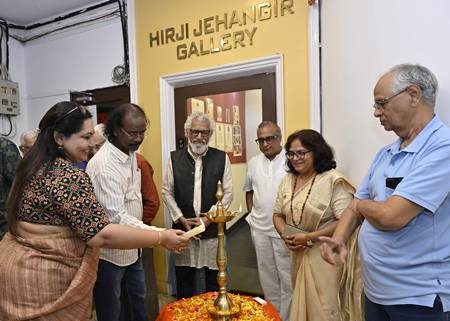
This show was inaugurated on 12th November 2025 by Honourable Guest Mr. Rishiraj Sethi (CA, CFA Director, Aura Art Development Pvt. Ltd. in the presence of Mr. Sidharth(Eminent Artist), Gurcharan Singh(Eminent Artist), Mr. Mukesh Parpiani (Eminent Photographer), Bhupinder Brar, Jaspal Kamana, Ram Pratap Verma, Nirlep Singh, Amarjit Grewal, Subhash Parihar among others,
Dev Inder tries to comprehend the world of relationships through is photography work. Therefore, the three dimensional space he steps into becomes a suggestion and a cue for him creating “a relationship between two figures that had not existed before” John Szarkowski in The Photographer’s Eye. Endowed with an acute sense of seeing everything in the landscape comes forward to help unlock the doors of perception. Things like fallen branches, everydayness of a billboard, reeds bending light’ly to the breeze, earth as seed of grass, clouds emanations of the trees, autumnal ciphers of grass are the anagrams he tries to read through portal of 35 mm. This diversity enhances his range of expression with images happening at the focal plane of his artistic consciousness.
Nothing dies.
The ephemeral and the eternal coexisting as juxtaposed poles guide the compassionate lense of Dev Inder. Whatever he touches comes alive. “Landscape are culture before they are nature; constructs of the imagination projected onto wood, and water and rock.” Simon Schama (Landscape and Memory). And so, imbued with presences; actual or of the imagination Dev Inder’s pictures are the sites where he goes looking for resolution.
The photographer till the moment of shutter release is a condensed presence, all faculties summoned just to see. The very next moment everything evaporates; the scene, the self, the eye. The photographer folds his tripod and walks back. Behind his back the scene disintegrates into a lot of rock, trees, water and light. What of the nature shall we capture in a moment so profound? Dev Inder recounts visiting the same place to have a better shot but concludes “It’s not worth it. The moment was only then.”
Aware of the paradox, Dev Inder invites life into the landscape with all its presences, real or metaphoric, arranging them in a rhythmic correspondence. The sky and the clouds in the pictures lend weight to the frames, at once embracing and inhabiting the scene. The elements have terra-firma to stand on and solid space to grow into. Restrained tonal range subsumes hierarchies in participatory fervour.
He is also a minimalist in the sense in which he transforms landscapes into relationships with minimum appurtenance. In one of the photograph through deft composition he has tried to bind the entire valley in visual embrace with warped arms as tendrils curling around the visibilities in the frame. It is a photograph about union, the tree supplanting Dev Inder to enter into an embrace. Dwelling on the same strand let’s look at the picture of the More’ plains from Ladakh. By now most of us are familiar with the sweeping vistas of More’ plains and to most of us a wide angle shot of its immense physicality is enough to fill the frame of our imagination. But Dev Inder’s picture shows a vehicle emerging out of the far end of the convergence. Far from being a sedate perspective shot it seems to suggest life emerging out of land’s end, throbbing with presence.
The contemplative spirit of his work is also visible in another photograph; a small plant with broad leaves cradled by a rock with a shoot circling over to the top of the rock. There’s a risk of it being viewed as a binary of the animate and inanimate. But rounded edges of the rock and the encircling branch, the third element in the picture, make it into a picture of ecology. Rock is not passive. Giving off itself, rounding off angularities it supports and germinates life. He rock is not a theatre where life is enacted. It is part of life itself. The picture stops us to ponder.
Dev Inder also converses through spatial ambiguity and abstraction. Pliant space gets modulated into anagrams of intrigue and discovery. Abstraction is a reality whose meaning is yet to arrive. But this doesn’t make all randomness abstract. Unless the artist stands at the cusp of intelligibility of the patterns he/she ciphers the end product would be still-born. Aware of this, his semantic lexicon employs symbols with cultural affinity, for example concentric rings at the heart of a rock evoke the memory of a tree, towering rocks come alive with human forms in another picture. By reflecting near in the far Dev Inder is able to locate rhythm in seemingly vast randomness of the landscape. At times acute compression of the perspective melds the landscape into architecture. Afterall “it is our shaping perception that makes the difference between raw material and landscape” (Simon Schama; Landscape and Memory).
On rare occasion when he uses negative space he does so with finesse and purpose. In the picture where a man rests under the shadow of a rock which rests upon rather tenuously on a bigger rock. The chunk of negative space on the left if not attended to properly would make the composition precarious. However an aware photographer waits for the arrival of human form to step into that space, solidly anchoring the rock. Visually addressing the precarity of the rock tremendously enhances the restfulness of the scene.
In creating a consciousness of relationships, intimacy and intrigue Dev Inder invites the landscape to partner him. Dead stumps rise up in vertical verse. Lifeless branches of trees lying on the ground, breathless and bleached, become animated limbs by delicate handling of the form and tones. Landscapes of grit start teaming with life and redemption. As Walter Pater has famously said “All art constantly aspires towards condition of music”, we hear notes of music rise in Dev Inder’s “The Echoes of Silence”
Nirlep Singh – Mohali, October 2025
“Echoes Of Silence” An Exhibition Of Photographs By Eminent Photographer Dev Inder In Jehangir Art Gallery
Read More
From: 11th to 17th November 2025
“UTKARSA”
Celebrating JMS Mani’s Mastery (1948-2021)
VENUE:
Jehangir Art Gallery
Kala Ghoda, Mumbai 400001
Timing: 11am to 7pm
Contact: +91 9886598387, +91 9538449359
This show was inaugurated on 11th November 2025 by Honourable Guests Mr. Anant Nikam(Veteran print maker, artist and former HOD all department of Sir J.J. School of Arts), Mr. Gourmoni Das(Director & Founder of Nine Fish Gallery and Dot Line Space Foundation), Ms. Ranjitha S – Director & Founder of JMS Mani studio daughter of JMS Mani, Mr. Darshan Kumar YU – Curator(muesmuseologist), artist & Thinker, Sushma Sabnis – Art writer & curator among others.
UTKARSA marks a sincere tribute to the life and creative legacy of J. M. S. Mani (1948–2021), one of Karnataka’s most revered modern artists and a transformative educator. Curated by Darshan Kumar YU, Curator(Muesmuseologist), artist & Thinker, Omit Curator NGMA, Bengaluru, and presented by JMS Mani’s family, this posthumous exhibition draws together key works spanning his iconic Badami series, expressive landscapes, and sensitive charcoal and mixed-media drawings and sketches, offering Mumbai audiences an intimate encounter with an artist who shaped both canvas and community.
His first solo show happened in Jehangir Art Gallery in 70’s.
Rooted in a rigorous academic foundation, Mani’s early practice honed traditional disciplines of light, form and perspective, later blossoming into an intuitive painterly vocabulary that balanced realism, symbolism and emotional intensity. His celebrated Badami series remains central to Indian art discourse, elongated rural figures, dusky-skinned, rendered with sincerity and grace, their gestures carrying the poetry of daily labour and social memory. These works reaffirm Mani’s lifelong conviction that dignity lives in the ordinary and beauty in lived experience. Equally powerful are Mani’s landscape studies, from the atmospheric ruins of Hampi to abstracted chromatic vistas, where nature becomes metaphor for time, memory and the human spirit. His drawings, often executed in charcoal, reveal a master draftsman able to distill emotion through line alone, capturing movement, fragility and stillness in equal measure. Throughout his evolving practice, Mani cultivated his studio as a sanctuary of creativity and learning, a space meticulously organised yet spirited, where students, artists and grandchildren entered freely. As a devoted teacher and principal at Ken School of Art, he encouraged experimentation, peer support and the courage to think beyond conventions. His belief in nurturing the next generation remains one of his greatest contributions to Indian art.
UTKARṢA honours not only a master painter but a mentor whose life’s work embodies artistic excellence, humility, and the deep conviction that art must stay rooted in humanity. This exhibition invites Mumbai art lovers to celebrate a legacy that continues to inspire—quietly, fiercely, and with unwavering devotion to the creative flame.
———–Sushma Sabnis – Mumbai.
“UTKARSA” Celebrating JMS Mani’s Mastery (1948-2021) I Retrospective Exhibition at Jehangir Art Gallery
Read More